A different study on what to expect
Narration
Listen or continue with the transcriptNarration
Listen or continue with the transcriptTranscript
Let me give you a different study - this is my own research on coding tools. The way this works is: if I'm doing a project with a client, I've got it in version control, so I have a complete history of everything.
What I've done is for each project that I started - where I started coding on the same day I met with the client and worked out what we were going to do - I can measure the number of lines of code that were generated.
Now, lines of code is not a great measure. Don't measure staff on how many lines of code they create, because that gives weird incentives. But I'm not being measured on the lines of code here - I'm being measured on "Did I actually solve the problem?" And the lines of code just happen to be a convenient metric.
We have these estimations called COCOMO II estimation, which is based on 80 years of programming history. We've seen that there's a rough relationship between the number of lines of code and how much it costs to develop. You look at a project at some point, count the lines of code, then ask the accountants how much it cost to get to that point. Logically, projects with huge numbers of lines of code cost more.
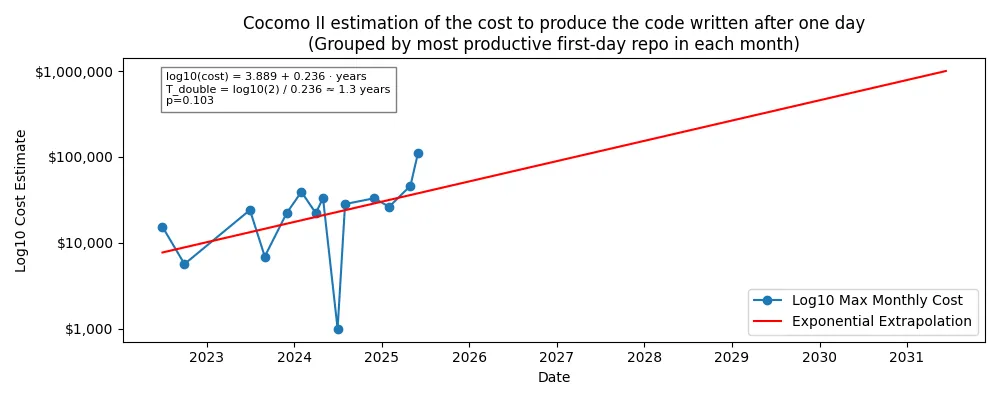
Based on that, we've got formulas. I can use a formula to say, "What's the 2021 dollar cost of the code that I produced in that one day?" Earlier this year, I hit a day where I did about 5,000 lines of code in a day, which would have been worth about $100,000 had it been developed in 2021.
If I extrapolate that trend, I see a doubling every 1.3 years, which is slower than the Meta results, but still remarkable. In my universe, what that's saying is by about 2031, we would expect that each programmer would be able to do in one day what would have been a million-dollar project in 2021.
We're racing through to a very rapid change in how software development is done, with huge productivity benefits available to those who can harness these tools effectively.